
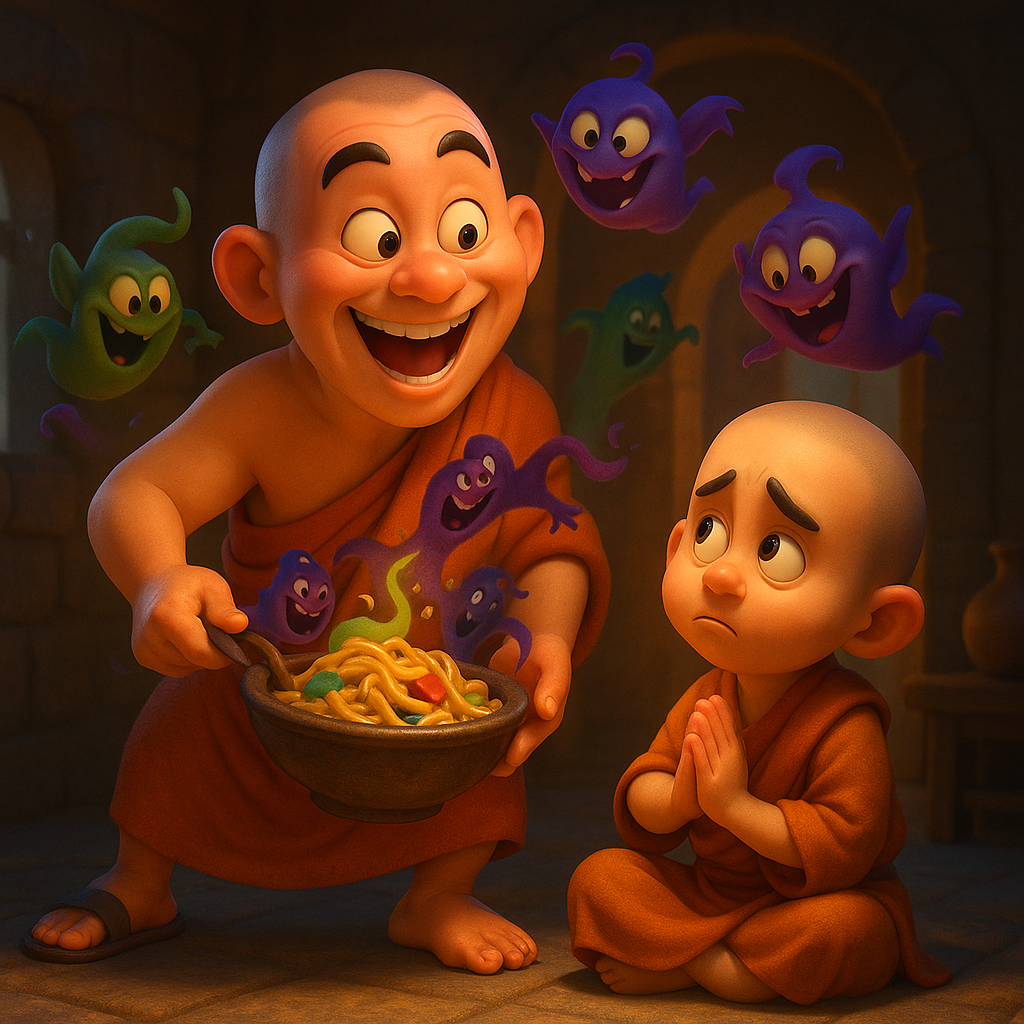
In the Buddha’s time, there was a frail, hunchbacked boy born to a very poor couple. From birth, life was hard—his mother’s milk dried up, and he barely survived on whatever milk they could beg from others. Somehow, he grew up, and later became a monk.
But because of past karma, he was the most unfortunate monk in the whole sangha. Even when he begged together with other monks, everyone else would get food—he would get nothing. Sometimes the food ran out just before his turn; sometimes the donor had to leave suddenly.
One week, things became truly extreme. For seven days, he received no food.
Ānanda, deeply worried, arranged for a householder to offer him a meal. But that day, the householder had to leave urgently and forgot about the offering.
On the fifth day, Maudgalyāyana went to the city, begging food with his great powers, filling two bowls. He ate one and brought the other back—but just before he arrived, a great flock of crows swooped down and stole every last grain. It was too late to beg again.
On the sixth day, Śāriputra himself went, got two full bowls, ate one, and brought the other back. Just as he reached the monastery, a band of invisible spirits appeared, grabbed the bowl, and vanished!
Finally, on the seventh day, Śāriputra went yet again. This time he succeeded, carried the food back carefully, and reached the little hunchback’s room. But suddenly—every door and window of the room slammed shut! No one could get in.
Śāriputra had to use his supernatural powers to enter. He called the monk to wash and receive the meal, but just as the hunchback stretched out his hand, the bowl fell straight through the floor and disappeared into the earth—into the Vajra ground, four myriads of yojanas below!
Śāriputra retrieved it with his powers and tried again. The monk brought the food to his lips… and invisible spirits snatched it away. Again and again, every mouthful was stolen. Śāriputra even tried to open his mouth for him with his powers—but the hunchback’s mouth was locked shut.
Only after noon, when monks could no longer eat, did his mouth open again. By then, there was nothing left to offer.
The monk simply said, “I am only thirsty. Bring me some water.”
Śāriputra fetched a bowl of water—but again, spirits filled it with ash, turning it into gray sludge. The monk quietly drank one sip, looked serene, displayed miraculous signs—thunder rolled, lightning flashed—and then he entered Nirvāṇa.
When the monks asked the Buddha why such suffering befell even an Arhat, the Buddha explained:
“Long ago, he once imprisoned his own mother for seven days without food or water, planning to starve her to death. Even when she begged for just a sip of water, he cruelly mixed ash into it. Because of that act, he fell into hell for countless lives and suffered starvation in life after life. Only after exhausting that karma could he be free — even as an Arhat, he had to face the final result.”
Lesson for the Class:
Even saints must bear the results of their actions. Karma never disappears — it waits for the right moment to ripen. This story reminds us: take care of your actions now; what you sow, you will surely reap.